"Alma, vida e poesia, tempo e pessoas queridas! Jornadas de tantos suores e de tantas alegrias!"

Caros amigos!

Bem vindos ao meu fogão virtual. Aqui vou manter atualizado sobre minhas andanças, fotos e trabalhos novos que venho escrevendo. Convido todos a participar, deixar recados e mandarem e-mails se quiserem!

Um grande abraço a todos e boa viagem por entre essas linhas...

Mostrando postagens com marcador Farm and Ranch. Mostrar todas as postagens

segunda-feira, 17 de maio de 2010

R.A. Brown Ranch

     One of the most relevant things that I learned traveling around and living abroad is that more important than the things  we learn are the people that we meet, because is through them that you learn, and more,  we improve yourself as a person. And is people that makes the life and traveling interesting, we always get to know some good souls around.

They are like iron brand, even for a brief moment of contact mark you for the whole life long. Some of those persons that makes difference in your life and are remarkable where you pass by are  Mr. Donnell Brown and his dad, Mr. Rob, owners and managers of the RA Brown Ranch in Throckmorton, TX. We got the chance to IMG_0085visit this ranch in a Beef Production class field trip, with Dr. Rathmann, a couple of weeks ago (April 23rd). The RA Brown Ranch is a family operation that has been with the Brown’s since 1895. Mr. Donnell is the 5th generation to manage the ranch and has been doing his job amazingly, what is shown by the ranch’s reputation among breeders and cattle raisers and by the numbers obtained after every annual sales.

Our first contact with Donnell was already shocking and  impressive. We were in a group of maybe 25 students and we stayed around him, close to his white feeder pickup and he introduced himself and talked a little bit about the ranch but his objective has get to know who he was dealing with. He asked our names, major, where we come from and where and how do we see ourselves 5 years from here. He asked our names, looking straight in the eyes, repeated it maybe three times and making some comments, than asked us about our jobs, hometown, or anything that he could make some connection. IMG_0124In the end of the introduction he went one by one saying each name, several surnames and also some hometowns. And he kept calling us by the first name until the end of the visit. That was amazing! Making a connection with that, Dale Carnegie in his book “How to win friends and influence people” (a masterpiece of people handling and management that I think any professional that want to be well succeeded needs to read), says that the most pleasant word for a person to hear is his/her own name. It’s an important part in dealing with people. Mr. Donnell is really skilled in dealing with people

The RA Brown Ranch is a seed-stock operation that produces and IMG_0119sells over 600 bulls and 200 second calf cows of the Angus, Red Angus, Simangus and Hotlander breeds. Besides that the ranch is traditional in Quarter Horse breeding too. RA Brown Sr. was one of the founders of the AQHA in the 1940’s and important breeder along the association’s history.

Right away Donnell presented the Ranch’s objective: produce genetics to improve profitability and sustainability of our costumers; and mission (in Donnell own words):“we are always striving to improve the efficiency of converting God's forage into healthy, nutritious, and great tasting beef to better serve His people”, while giving us a class in genetics and looking close to a selected Red Angus cows that will be used as eggs donors.

For achieving the ranch goals and mission the Brown’s follow rigorously three rules:

1.select the cow that best fits your environment;

2.select the bull that best complements the cow  and produce a calf that best fits the market; and

3. select breeding systems that best fits your environment.

IMG_0099The selection criteria used is EDPs and it work better for bulls (more offspring) so, the bulls with better offspring are kept to improve the herd’s progeny. The  fast turn over of the cows works in shortening the genetic interval (not as much as changing the bulls every year, but this technique helps decreasing mistakes on breeding).  That’s why most of the cows are sold with three years. They keep 85% of the heifers for replacement.

The R.A. Brown Ranch is also a pioneer in the IA and embryo transfer (since 1969 and 1980’s, respectively).  All the animals are synchronized and AI breed (helps improve the value).

Annother differential of the ranch is the high fiber diets, even in feedlots, what help the bulls to get prepared to the breeding season, from the pin straight to the field. The lower energy/protein diet also make the bulls grow slower, avoiding any joint or over fat problems caused by feedlot diets.According to Donnell the animals are ready to go to the field.

For such quality of animals they need a good specialized and well trained crew. One of the most important things in the seedstock operation is recording data. That will make the difference when breeding and selling the animals. The crew is trained in the farm and, in case of a new technology being implanted, Donnell also take his employees to another farm to see how it works. With explanation and hard work they are able to overcome the traditional methods of cattle handling. With his experience with animals and the help of Dr. Grandin they built in the farm a amazing and practical working facility, with hydraulic squeeze chute and several alleys designed to facilitate the animals driving to the chute.

IMG_0160That’s not just a simple cow-calf or seedstock operation. Is a really well managed and planned enterprise. I am very pleasant that I get the chance to meet Mr. Donnell and Mr. Rob Brown. Thank you for opening the gates of your ranch for us.

quinta-feira, 22 de abril de 2010

News March and April:

Well, time flies here around West Texas, as fast as the wind blows this spring. Yes! Dust all around! Dust storms and dirty houses. And I am realizing that my days here are also growing shorter and shorter. I had so many remarkable day here in US that is hard to remember all.

But as I hadn’t written anything this last few days, here we go for the updates. First a few weeks ago I have been invited to give a lecture in one of my friend’s Spanish class, Heath Wing. I went there to talk to his students about South Brazil, Uruguay and Argentina and the Gauchos culture. Was really nice go there to talk about where I come from. At the end of the class I gave Heath my book and because of that I had an invitation to go read some poems at the CÉFIRO’S 11th Annual Conference at the Foreign Language department at Texas Tech. It was an amazing experience showing a bit of my art and our tradition to people here, it makes me more proud of the place I come from. The acceptance of the poems was great and surprised me, and i got really happy because of that.

Easter was a blast! I had a great visit of a friend from Brazil, Adriana. We used to work together at theIMG_0753 (2) microbiology lab at the Agronomy College in Porto Alegre. Now a days she is living in Florida and is a Faculty at UF. Her staying here was short but enjoyable. She arrived Saturday morning and we went around TTU campus and went to a Heath’s  farm for lunch. Francesca, a friend from Italy also joined us in the trip.   Was a big Easter lunch and we went shooting discs with 20 and 12 gauge shotguns. I got some really good shots, IMG_0784 even thought that was my first time doing that. Texas is all about horses and guns. After that we went back to Lubbock and made a really good barbecue with some of mine and Brando’s friends. We had a great time. Adriana went  back to Florida Sunday’s afternoon.

A few weeks ago I joined Dr Brady, the Horse Production professor, and her students and we went to visit two famous horse ranches. One was the Pitchfork Ranch (http://www.thepitchforkranch.com/) and than the 6666 Ranch (http://www.6666ranch.com/), two old big ranches with where the actual mixes with the history and the legacy makes you never forget about the name. The ranches are amazing, for the horse lovers the 6666 Ranch breeds something around 3000 mares (I am not sure about the numbers, but was the number that some one gave me). Their facilities are amazing, with everything for horse training, clinic, collecting stallions, working and race horses and going on. The Pitchfork Ranch

history goes to 1883 and is one of the biggest ranches in Texas. It’s  160,000 acres still under the same family since its foundation. There the branding is done in wagons, in the “old way”  roping and riding their famous gray horses. Was amazing visiting those two ranches. If you are interested, this brief video shows a little bit of the ranch.

Last week I was surprised by an invitation from Dr. Pond to go to an interview at the local radio station. We went there to the Ag Talk with Eddie Griffis in the 950 AM to talk about the exchange program, a bit of my staying here in Texas and, most important. talk about Brazil. Is always a pleasure talk about where we came from, show them with proud facts about our country. Was really enjoyable participating of the program. Unfortunately I could not put here the link for the interview because they already changed it, but I will try to find it again and put in the blog.

Now, talking about school, one of the things that I most like here are the labs. We really got to go to the duty. In the beef production lab we do things like planning management, spreadsheets but also get dirty palpating, measuring pelvic area, collecting bulls, and on and on. Yesterday in the sheep lab I almost felt back to the southern Brazil prairies, shearing sheep.

Another activity that I participated helping in the organization at the Animal Science Department was a High School Livestock Judging Contest. There are several categories of animals (sheep, cattle and hogs, different sexes and ages) and the young judges have to select 1st to 4th place (in 4 animals categories) or keep/cull four and four (8 animals categories). In this keep/cull category, the students are given some written data about the animals that they are facing and they have to choose which one they would like to keep in a situation where they are selecting, for example, heifers for breeding. What amazes me is the attendance to events like this. Is impressive. And they are forming new professionals, the kids are since young in contact with the university and  incentive the interest in this area. Was a pleasure helping Dr. Rathman and the Texas Tech Livestock Judging Team there!

I think that is all for now. See you in the next post!

domingo, 14 de março de 2010

Estacado Sheep Feedlot

A few weekends ago Gustavo (I have already talked about him, he is another Brazilian from ESALQ, in the same program that I am here) and me went to visit a sheep feedlot in Dimmitt, TX. This feedlot was recommended for me to visit by my Sheep Production professor, Dr. Sam Jackson. The manager, Mr Beerwinkle received us really politely and showed us the facilities and explained how he runs the feedyard. Most of the lambs come from San Angelo (the Hill County, 260 miles south), mostly black face (Hampshire and Suffolk) and merino crosses. The quality of lambs varies a lot and the days in feed will depend on that. There are some lambs that come from New Mexico, really good animals, that enter in the feedlot with 94 lb and are kept there for 70 to 90 IMG_4083days. On the other hand there are some light animals that enter with 50 lb and need to be feed for 180 days. Another factor that dictates the days in feed is the market that they will be sold. The muslin ethnic market wants a small framed, well-muscled animal (up to 90 lb, against the 120 lb of normal market), with less fat, preferentially male and uncastrated and for that they around $1.40/lb (against $0.95 – 0.96). The main destination for this category is New Jersey. Other normal destinations are Denver, CO; Dixon, CA and Detroit, MI.

The lambs are feed different diets according to how long they are being fed.IMG_4082 The initiation diet is 40% chopped hay, 20% alfalfa, cracked or steam flaked corn and cottonseed hulls. The final diet is 87% whole corn, alfalfa pellets tetracycline and mixture (minerals) and is fed for approximately 20 days. To sheep there is no problem to feed whole corn because of the better chewing that they have compared to cattle.

By the time we were there the capacity was not fulfilled (around 50,000 hd) but there were arriving the fall born lambs that would be finished for the spring market (Easter) with 8 months. In the slaughter they receive a bonus of $9.00 for the pelt (hair sheep has no value) and a disIMG_4087count of $25.00 for break joints. The lambs that were there were sheared in January to optimize gain and wool revenue (even thought that the wool price makes no more that covering the shearing costs).

Thanks Mr. Beerwinkle for the visit!

domingo, 24 de janeiro de 2010

Red Doc Farm

Last weekend my friend Emilio Sanchez invited me to go to his farm in Belen, New Mexico, with him and another friend from IMG_3862Nevada, Austen. His father, Doctor Sanchez, has been raising Santa Gertrude and working in genetics improvement for 30 years. In the farm they have a selection of show animals and bulls for sale and also some heifers and steers that are being prepared for the bigger feedlots. For feeding the animals they have in the farm alfalfa and another grass (that I don’t remember which) all flood irrigated (now was all dry because of the winter). IMG_3910They also buy alfalfa and red-top hay and fed cracked corn. The pastures are used for hay and grazing. In the other fields that they have is all rangeland. Is amazing how the animals can survive with sow few supply of feed and having to walk for miles searching for water. I have never been in the Sertão (Northeast Brazil) but is probably similar to the conditions around there. The annual rain average is something like 9 inches (230 mm), so you can imagine how dry it is. The animals in the farm were all in a really good corporal score (Emilio said that is due to the molasses and mineral supplementation that the animals hIMG_3901ave in the rangelands and feed for the fed animals) but we saw some other animals in farms around that were weak and score close to 2 – 2.5. There is a good variety of grasses and shrubs for the animals to eat (blue grama, ) that can even finish animals in those adverse conditions. Another source of feed that the animals use is the cactus (like the “plama” in the Sertão).

Because it is a arid region the hooves of the cows grow a lot (there IMG_3891is no rocks to serve as sandpapers) and we had to take some cows to cut the hooves. For that, a sanding machine is used and the cows are “laid down” in the chute (hydraulic chute) and the bottom part of the chute (now horizontally positioned) opens so you can tie the members and work safely (safety first is always the rule).     

IMG_3905It was a good weekend working, something that I miss a lot here. Thanks a lot for Emilio, Doc Sanchez and all the family for this great time and lots of learning.

quinta-feira, 17 de dezembro de 2009

Mais andanças por fazendas

Buenas pessoal!!

Desculpem minha ausência das letras, mas esses úiltimos dias tenho corrido um pouco mais que o normal e a inspiração não andava muito no meu costado. Mas bueno, desse último mês tem bastante histórias, vou contando elas despacito em diferentes posts para não enjoarem de ler.

Primeiramente quero agradecer o apoio de todo o pessoal ai do Brasil e aqui dos EUA para conseguir mais um feito. Consegui autorização e apoio de todos os lados (TTU, Agro, Capes) para poder ficar mais um semestre aqui nos EUA. Vou ficar aqui no Texas até Junho de 2010 aprendendo sempre e mais. Estou muito feliz pelo feito e muito grato pelo apoio principalmente de meus professores aqui e do meu coordenador ai na UFRGS, professor Emerson Del Ponte, que sempre acreditou em mim e no meu potencial e principalmente tem confiança na minha pessoa. Obrigado Prof. Emerson!! O professor Aderbal e o professor Christian que também me incentivaram a ficar. Pai e mãe muito obrigado também, pois sem vocês não seiria po$$ível ficar aqui (he.he).

Bom, vamos ao "relatório técnico" :

Desde que cheguei aqui no Texas tenho procurado aprender e obser var ao máximo tudo que posso. Por essas andanças tenho observado aspectos, técnicas e manejos que, alguns, meus olhos julgam "errado" (baseado no meu background). Felizmente sempre (e principalmente quando estou fora do meu ambiente) tenho em mente a máxima que "temos dois olhos e duas orelhas para observar e escutar bem e mais, e apenas uma boca para poder falar menos". Com isso tenho formado muitas novas opniões sobre aspectos que julgava saber algo. Quando cheguei aqui me falaram em manejo das pastagens por fogo. Na hora pensei "mas que coisa arcaica!! Como podem ainda fazer esse tipo de manejo?". Em uma das aulas com a Dr. Allen perguntei por que essa "adoração" pelo fogo que o pessoal tem aqui (existe uma cadeira aqui na faculdade que se chama "fire ecology"), ai ela me fez pensar um pouco sobre a região onde estamos (semi-árido, chove 400 mm por ano, plano e ventoso) e sobre eventos naturais e históricos. Tendo isso em mente, vê-se que o fogo se faz presente desde os tempos antigos, se não por eventos naturais por ação do homem nativo que habitava a região (tempo de retorno de 6 anos ou menos). Mesmo sendo pelo homem, há bastante tempo para a seleção e adaptação das espécies ao manejo por fogo. A quantidade de folhas senescentes que se tem nas pastagens aqui não é muito grande mas mesmo assim havería acúmulo de material morto na superfície, pois a taxa de decomposição é baixíssima (não tem humidade suficiente). Tendo em vista isso, é fácil para que se inicie fogo. Por experiência própria a Dr. Allen ela nos contou que colocaram fogo num experimento e tinham umas bandeirinhas plásticas (que usam para marcação de linhas de trasmissão de energia, água...) e que o fogo passou tão rápido que havia bandeiras que não foram queimadas. Esse é o tipo de fogo desejável, rápido, pois assim não queima a superfície do solo. É muito importante o entendimento do ambiente e dos fatos que constituem esse ambiente para que possamos entender o manejo, as utilizações e principalmente, para que formemos conclusões sobre o que estamos vendo. Felizmente guardei meus pensamentos para mim mesmo e não falei para ninguem que faziam manejo "errado". Se aprende muito por aqui!

No início de novembro estive com o Rodolfo (um amigo de Campina Grande, PB, que veio fazer umas pesquisas de mestrado aqui) em uma fazenda de um cara que conheci em um jogo de Football aqui na Tech. Wade Davis é engenheiro de helecóptero e nas horas que pode é fazendeiro (assumiu a fazenda do pai há alguns anos quando ele faleceu) e lá tem mantido um rebanho de novilhos certificados (hormone and medication free) para recriar (400 até 800 lb)e vender aos confinamentos na volta. Interessante foi o método de compra dos animais: existe um site na internet (http://www.superiorlivestock.com/) que tu anuncias animais para venda e dá as características; tudo tem garantia; o comprador acessa o site e procura o que mais lhe agrada; existe um representante deste site em cada região (em vários estados dos EUA) que avalia os animais para venda e acompanha a chegada e inspessão dos animais comprados; se há algum fora do padrão o site se compromete em repor o animal ou repor o dinheiro. Muito interessante o método e, segundo Wade, é muito confiável e nunca teve problemas. No dia que estavamos na fazenda dele ele esperava uma carga de animais vindos do Wyoming (19 horas de estrada) que foram comprados para fechar com as características dos animais certificados que ele já tinha pastando. Com essas certificações ele consegue até $10 (se não me engano)a mais por cada 100 lb de peso vivo (cwt). Ele cria os animais com feno (red top) e pastejando trigo.

Outro final de semana depois fui visitar o sr. Sammy Brown, dono do Brown Feeders, em Friona, TX. Conheci ele em uma reunião do Texas Cattle Feeders Association que fui em Amarillo umas semanas antes da visita. Muito atencioso, me mostrou o confinamento de 5000 cabeças que tem para preparação dos animais para confinamentos maiores. Ele faz esse serviço pois em confinamentos grandes há um custo maior de tratamento dos animais, por isso fazer acordos para alguem fazer essa primeira etapa de mudança de ambiente e alimentação (depois de desmamados). De novo me chamou a atenção a mão-de-obra utilizada.. Na propriedade são só um vaqueiro e um funcionário para alimentar os animais contratados e mais o dono e a esposa. O pessoal mete a mão na massa mesmo. Andando pelas baias ele me mostro diferentes padrões de qualidade de animais (diz que há alguns lotes provindos de estados onde até 30% dos animais adoecem, outros não chega a 10%). Outro dado que confirmou das aulas e de outros confinamentos que visitei é o problema com Charolais. É problema no confinamento (para engordar) e difícil de passar adiante também. Os animais Angus e Hereford cruzados com outras raças são os preferidos dele. Me agradou bastante do amochador que eles usam (foto) que é a gás e nunca esfria (o amochador é a gás, não precisa de aquecedor). As mascas em geral são todas elétricas. As pistolas de vacinação eram colocadas em uma bandeja de pintura com uma esponja embebida em solução desinfestante. Achei bem boa a ideia, pois acaba com aquele negócio de por a pistola direto na mesa e de bater a agúlha (que acaba perdendo o fio). Além disso creio que ajuda em manter a higiene.

Outro feito também foi que fui à fazenda do meu amigo Chris

Ashbrook acompanhar e participar do final da colheita de algodão - strip cotton (as fotos não são da fazenda dele). Bem interessante! Estava com receio de que não participaria de nenhuma colheita de algodão aqui (quase inaceitável estando numa das regioões maior produtora do produto no mundo).

Na ida para o Brown Feeders cruzei por um confinamento de ovinos. Quero ver se consigo voltar lá para visitar. Outra coisa que vi interessante foram os silos (para silagem) aqui. Quando fazem a silo compactam bem e não colocam lona por cima: chove tão pouco durante o inverno que não é uma grande preocupação com possíveis perdas por umidade. Na Argentina eu já tinha visto isso, mas lá estragava um pouco mais, por que chove mais, mesmo assim o segredo (sempre) está na compactação. Se tiveres um silo bem compactado com ou sem lona só há perada de uma pequena camada superficial.

Muito obrigado Wade Davis, Sammy Brown e Chris Ashbrook pela oportunidade da visita.

sexta-feira, 30 de outubro de 2009

Hopper’s Farm – Petesburg, TX

Já fazia um tempo que eu estava para ir visitar a fazenda do irmão do Dr. Hopper, Ronny, e não tinha a oportunidade. Na última sexta-feira (dia 23/10) Thomas e eu fomos à Petesburg para fazer essa visita. Thomas é um dos alunos da Tech que vai para o Brasil ano que vem, fazer parte do mestrado dele conosco lá na UFRGS, e o pai dele trabalha nessa fazenda que nos fomos visitar.

Não tive a oportunidade de conversar muito com o proprietário, mas o filho dele, Arn (com  quem trabalha em parceria), nos recebeu muito bem. Conversamos muito além das cerdas da propriedade e entendi um pouco mais o estilo do pessoal aqui.

Uma coisa que me chamou muito a atenção na propriedade foi a organização em tudo, desde peças para reposição, maquinário, ferro-velho, documentação e tudo mais. Isso ajuda na otimização do tempo de serviço, eles não tem que procurar nada pois sabem onde está e se precisam carregar alguma coisa é só pegar a empilhadeira e colocar no reboque. Ferro-velho não se vê muito, como eu já tinha comentado de ter visto em outras propriedades. Quando entramos no galpão de peças e oficina (é mais que um almocharifado) me impressionou a quantidade de pratelerias com gavetas e todos os tipos de peças e equipaentos como torno e solda necessárias para quaisquer reparos. O argumento para tamanha infraestrutura e estoque é que leva muito tempo para ir à cidade, buscar uma peça que falta e voltar (cerca de 30 a 50 minutos), além do combustível gasto e de alocar uma pessoa para fazer isso. Parece pouco, mas é um tempo perdido importante se considerarmos época de colheita, ainda mais que eles fazem colheita para outros fazendeiros na volta.

IMG_1142

As terras da propriedade não são todas juntas, isso dificuta a logística, então fica complicado de terem que votar ao galpão para fazerem reparos. Por isso, para facilitar ainda mais, eles tem uma van-oficina, com aparelho de solda, gerador e outras ferramentas, e ali carregam tudo necessário para reparos a campo. Outro aspecto distinto da propriedade é o aproveitamento de materiais. Tudo o que pode ser reutilizado é estocado e restaurado, se não tem mais utilidade é vendido para outras pessoas como peça usada ou para ferro-velho. Arn está sempre procurando materiais que possa comprar por preço barato para reutilizar. Uma das últimas aquisições foram canos galvanizados de um antigo poço, que ele planeja utilizar para fazer mangueiras para o gado (embora no momento não tenha nada de animais).

Em meio a uma das conversas Arn me disse que um das grandes fontes de renda para eles é colher algodão para os outros, pois o algodão de eles plantam não gera uma entrda considerável, que se não fosse pela tercerização de serviços nessa área, não teriam resultados com o setor. É interessante rever alguns pontos sobre isso, pois ele não foi a primeira pessoa a me dizer a mesma coisa. Considerando isso, na mimnha opnião, o produtor de algodão segue fazendo plantando pois: 1) ganha subsídeos do governo (o que parece que está por mudar); 2) já é uma tradição e não quer parar de plantar, até por que “não sabe fazer outra coisa”; 3) tem renda não-agrícola, ou 4) tem medo de mudar de setor no mercado, mudar o tipo de exploração, por desconhecimento, falta de força de vontade ou (uma aspecto que me chamou a atenção) por incerteza na sucessão. Os gastos com algodão são bastante altos (vou pesquisar a respeito disso um pouco melhor para poder colocar alguns números), entre eles o gasto com energia elétrica para irrigação corresponde a aproximadamente 40% do total.

Nessa propriedade eles também plantam milho irrigado, uma lavoura não tão comum aqui nessa região por causa da escacez de água. Eles chegam a aplicar 20 a 22 polegadas (mais de 500 mm) de água no milho. É de se pensar a respeito da sustentabilidade e rentabilidade desse cultivo, pois aqui muito se fala da superutilização do Aquífero Ogallala (abaixo vou colocar alguns links com informações sobre o aquífero), que vem apresentando redução no nível estático de água durante esses últimos anos. Mas, todo o caso, me disseram que era uma cultura rentável para o nível tecnológico que eles usam.

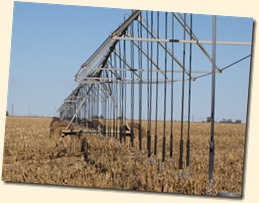
Irrigação é impressionante aqui em toda essa região, até por que sem ela não se produziria o tanto que se produz de algodão (20 a 25% de todo o algodão dos Estados Unidos só nessa região em cerca de Lubbock) e nem outras culturas como o sorgo granífero, alfafa para feno e um pouco de trigo. Nessa propriedade há uma rotação de áreas em baixo dos pivôs, ou seja, todo o ano tem pivô que fica parado ou subutilizado. Isso se deve principalmente à capacidade de suporte do aquífero. O maior pivô que eles tem na propriedade é de um pouco mais de 3/4 de milha (mais de 1200 metros), que aproveita cerca de 65% da área (80 hectares), e não mais por causa de uma estrada que corta a fazenda. O custo de implantação desse pivô, segundo o dono, é mais ou menos a metade do que seria normal, devido à área abrangida (U$250, apriximadamente).
IMG_1130

Ainda sobre algodão, notei que quase sempre as linhas de plantação são curvas, mesmo não estando em baixo de pivô central (aqui também tem irrigação subsuperficial por gotejamento, que inclusive o governo paga metade dos U$1.000 por alqueire, e algodão não irrigado). A resposta pude presenciar no domingo passado quando voltava do Novo México quando enfrentamos uma tempestade de poeira. A erosão heólica aqui é muito intensa, então o plantio em curvas evita que o vento ganhe intensidade nas entrelinhas (que por sinal quase sempre descobertas) e eroda o solo, além de que a poeira “queima” o algodão (suja), diminuindo o valor de mercado.

Essa também foi uma das poucas propriedades que fui que se faz “plantio direto” (pelo que entendi é mais um cultivo mínimo), com rotação de culturas. Se não me engano, eles fazem uma aração a cada 3 anos (a justificativa é o manejo de nutrientes, não entendi muito bem o propósito). Em conversas com outros fazendeiros aqui, perguntei por que não faziam o plantio direto, as respostas eram variadas, do tipo: por causa do manejo de daninhas, por que não é eficiente, por que sempre plantaram no convencional, outras que não lembro… Mas quando perguntava sobre cultura de cobertura sempre me diziam: “não plantamos nada de cobertura para não gastar água”. Não achei uma razão boa para não colocar cobertura, pois muitos deixam o solo descoberto e há uma perda grande por erosão heólica, perda de nutruentes por escorrimento (não tão importante por que aqui é muito plano, mas o solo é argiloso), e materia orgânica creio que não deve ser maior que 0,5%.

Nessa propriedade o Arn me disse: “eu faço plantio direto e tenho sempre cobertura por que assim consigo colher o máximo possível de água da chuva, já que a matéria orgânica consegue absorver mais do que seu peso em água e estocar para a próxima cultura, isso me diminui bastante a necessidade de irrigação. Quando planto algodão sem irrigação ou sorgo sem irrigação, esse estoque de água da MO é a fonte principal para a cultura, já que as chuvas são escaças. Quando chove (e geralmente a intensidade é grande), consigo absorver o máximo dessa precipitação.” Interessante ponto de vista…

Gostei de conversar com o Arn pela visão de negócio que ele tem. Infelizmente notei (e já havia percebido em outras conversas com outros prorpietários) o quanto o pessoal é restrito ao local onde vivem. Não querem sair, não conhecem muito à volta. Espero estar enganado, mas ao que parece, mara muitos mas não generalizando, que o que importa é o que eles tem à volta, não importa os outros estados, quanto menos outros países. A impressão que dá é que falta uma visão de mundo. Mesmo assim, o nível de trabalho e tecnologia é muito alto, e, mais interessante, quem trabalha na propriedade são os donos (creio que já falei isso, mas reforço) e um ou dois funcionários. O pessoal sobe mesmo para as máquinas.

Bueno, acho que é isso! Assim que der volto a escrever!

Abraço a todos!


Mais informações:

Aqui tem um trecho da introdução de um artigo da Dr Allen (2004)  sobre sistemas agrícolas aqui na região:

“CONVENTIONAL MONOCULTURE AGRICULTURAL SYSTEMS can reduce the quality of soils by loss of organic matter and structure because of low levels of organic inputs and regular disturbance from tillage practices. Cotton produced in the Texas High Plains region has been under continuous monoculture and conventional tillage systems that contribute to wind-induced soil erosion and reduce organic matter of these semiarid soils (V. Allen, unpublished data, 2004). Besides loss of quality in soils under continuous monoculture cotton systems, there is concern that irrigated cotton is using water from the Ogallala aquifer at rates that exceeds the water recharge. Thus, recent efforts are focused on developing integrated cotton cropping and livestock production systems that reduce water withdrawn from the Ogallala aquifer and that provide more conservative sustainable agricultural practices”

http://soil.scijournals.org/cgi/content/full/68/6/1875

Mais informações sobre o Aquífero Ogallala estão disponíveis nesses sites: http://en.wikipedia.org/wiki/Ogallala_Aquifer; http://www.waterencyclopedia.com/Oc-Po/Ogallala-Aquifer.html


terça-feira, 20 de outubro de 2009

Lubbock Feeders - Feedlot

Here there is some information regarding a visit to Lubbock Feeders (http://www.lubbockfeeders.com/) that I went with the feedyard management class on September 29th.

The Lubbock Feeders is located close to the city of Lubbock, in a strategic point close to the rail road and some highways. Their capacity is 45,000 hd at the same time, what would mean 99,000 hd per year. By the time that we went there were 25,000 hd being fed. The animals are preferentially Mexican cattle and crossbreed, because of the adaptation, conversion ratio and easiness to sale. There were some Braford in one of the pins, but mostly they are a mix of colors. The most difficult animals for sale are the Charolais. 

IMG_1075

The animals are feed once a day, preferentially in the same time every day. The routine helps the cattle to get adapted easily to the feedyard and improve gain. If they take too long to feed the animals get more stressed.

 IMG_1062

Feed is flecked corn basis, with distillery residual and supplementation with micro ingredients and roughage (hay). The distillery residual is difficult to manage because has high humidity (means that they are buying water too) and needs to be used in the same day.  They are able to make 400000 tons of feed per day. The facilities are 3 corn fleckers and 2 big mixers. The feed is delivered by trucks in, normally, at the same time every day. The feed production per day is about 1 million pounds.

There is no shade for the animals in the pins. There are two kinds of pins: one with a dirty floor and other with concrete floor. In the pins there are the bucks and the water tank as well as an irrigation system (sprinkler) that helps to maintain the temperature comfort and keeps the dust down.

There are 20 employees working in the feedlot. They are responsible for everyday operations, such as feeding, taking care of ill animals, cleaning and moving cattle when needed and managing. There are more 2 hired professionals that assist the feedlot: one nutritionist and one veterinary. Daily observations consist in looking for animals that present atypical behavior indicating illness or problems in adaptation to the feedyard or the feed. If there are any animals with problems they are take to some facilities that are located in the middle of the feedyard that are called hospitals and they are kept there receiving special cares. The responsible for taking care is called “doctor”.

The mortality is about 1% in spring and summer time and 2% in winter an fall time. This difference is, probably, due to the climate changes during the winter (what was explained by the manager), even though they do not have a too cold winter, so there are probably other more factors included in this indices. Probably because the age of animals when they come to the feedlot (after wean) joined to the low temperature and stress due to the new feed and environment.

The budget for running the feedlot is US$25 million (and according to the manager is not one considered big, Cargill’s for example is about $400 million) and the margin that they have to deal is very short and sometimes they run out of money too. This is not considered a very big feedlot. The fly control costs US$15,000.00/ year and the control company goes to the feedyard once a week to verify and make the control.